
Dr. Morgan Hurm, a seasoned sixth-grade general science teacher at Abington Middle School, has a strong relationship with meteorology.
Now in his 24th year in the district, Dr. Hurm taught earth and space science for 20 years before taking on general science for the past three years. He says it’s been “refreshing to teach things I haven’t taught since college student teaching.”
“It’s a lot about energy, states of matter, meteorology, biology. It’s a sprinkle of everything. It’s a great subject to teach,” he said.
A self-described “science nerd,” Dr. Hurm says his interest in everything weather began when he was an elementary school student in his hometown of Newark, Delaware.
“As a kid, I couldn’t understand why certain places got more snow than others. Our snow forecasts were rarely accurate, so I started reaching out to local meteorologists to try to understand more,” he said. “I still keep in touch with my third-grade teacher. He’s told me that every Monday morning, I did the five-day weather forecast. He said I’d be so excited about the possibility of a snow event. I think it’s just a peaceful thing when it’s all white outside and the world stops. There’s not much else that puts everything to a halt and brings people together. Ever since then, I’ve been learning and thinking about it.”
Dr. Hurm attended the University of Delaware before transferring to Penn State University’s meteorology program. He went on to earn a PhD in meteorology with a focus on accurately forecasting snow in and around the Philadelphia area.
“When I came to Abington right out of college, it was exciting because I was further north. In 2003, we had the President’s Day storm, which was probably the most unique storm we ever had,” he said. “It was basically a stalled storm that lasted 36 hours. We would have had over 40 inches had it not changed to sleet.”
A friend of Glenn “Hurricane” Schwartz (a fellow Penn State graduate who went on to forecast for NBC10) Abington middle schoolers received virtual lessons while he was still on the air, courtesy of Dr. Hurm. He has also opened his classroom’s doors for FOX29’s Drew Anderson, among others in the field.
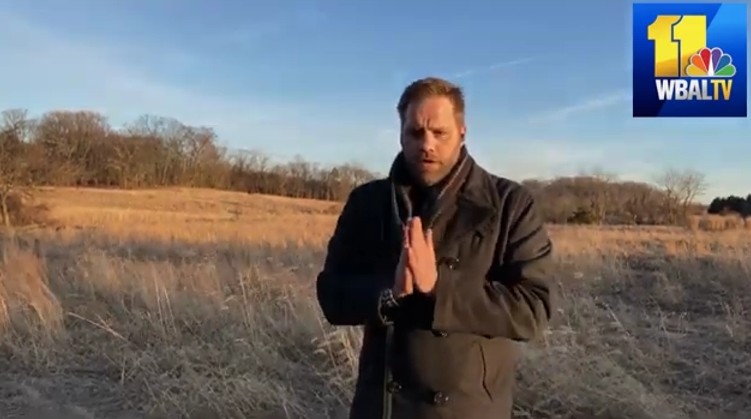
“‘Hurricane’ was very helpful. I sometimes give the kids a prediction. I also have my own Youtube channel, and I made a hypothetical blizzard video for an 8th grade lesson a few years ago,” he said.
The video:
As far as long-term predictions go, Dr. Hurm says he prefers to predict near-term events only, as “seasonal forecasts are asking for trouble.” That said, greater Glenside can expect a “real winter based on, among other factors, the jet stream. That dictates where the water is coming from,” he said, noting that “it will snow in December” and that our area can expect “at least one six inch-plus storm.”
His 2025-2026 seasonal forecast is below:
There are a lot of moving parts here. It is very difficult to put together a “meteorological winter” forecast (December 1 – March 31) before mid-November but we’ve just crossed that time frame and the data at present is more clear than normal for the next 4 – 6 weeks.
We haven’t had a major snowstorm since January of 2016. An eight-year stretch without a widespread 8 inch plus snowstorm in the area is not unheard of, but on the rare side. Here are the current observations and speculations:
1. Ocean temperatures. Based on our latitude of 40 degrees north, most of our weather systems come from the Pacific basin. That’s because our winds here are primarily from the southwest. However, even when storm systems develop in the Gulf of Mexico or along the Atlantic coast, what is happening in the Pacific or more accurately, the troposphere of the Pacific dictates the direction in which those storms go. So starting here, we are currently in a weak La Nina in that the equatorial ocean temperatures are slightly cooler than normal. We are also in a negative PDO which only means that the western Pacific Ocean temperatures are warmer than normal. What both of these influence are the behavior of the jet stream – the polar jet stream. Based on similar years called analogs, this creates an active northern jet stream that has the potential to “buckle” allowing for storms to develop in favorable locations to create our traditional winter weather events. But just because you have a good quarterback doesn’t mean you always win the game.
2. The NAO (North Atlantic Oscillation). Over 90% of our 8 inch or more snowstorms have occurred during a negative NAO oscillation. The NAO is a numerical indice that indicates air pressure in the north Atlantic over and near Greenland. During a negative NAO, high pressure dominates the area. Downstream to the southwest, in response to this, the polar jet stream dips to the south, interacts with moisture from the gulf and southwest Atlantic and generates a storm system east of the Mississippi River. Relative to number 1, the NAO is more likely to be negative more than positive during the winter months.
3. Ahhh…the polar vortex. The most overhyped and misunderstood meteorological term used in the winter. The polar vortex is always present in the winter. It just usually rotates around the poles. However, sometimes it gets disrupted and usually it is disrupted by a SSW (sudden stratospheric warming event). Most don’t know this but in the stratosphere temperatures actually increase whereas in the troposphere temperatures decrease with altitude. When the stratosphere near the poles warms rapidly to polar vortex (frigid cold air) is disrupted and displaced. Sometimes it splits in one lobe, other times in multiple. Now, the lobes can go in any direction. And this is extremely difficult to predict ahead of time. Models are favoring a warming event to occur at the end of the month leading to a vortex disruption. If it swings in our direction, very cold and dry air will setup in Canada allowing for one of the ingredients for an east coast snowstorm to be present. Additionally, this would be the first SSW event to occur in November in the satellite era. Here is the problem. Computer models are notorious for predicting these events or predicting them weeks ahead of time. I’m not sold on it. If it comes to fruition, expect a December cooler with more winter weather compared to the last decade of December months. As a side note, there is another indice referred to as the MJO (Madden Julian Oscillation). This oscillation has 8 phases and depicts tropical convection the the western Pacific Ocean. Over 90 percent of our 8 inch plus snowstorms have occurred during phase 7, 8, or 1. Currently we are projected to go into phase 7, 8, and then 1.
Total Winter Snowfall:
Abington averages 3.1 inches of snow in December and averages 23.6 inches of snow in winter.
- December: Above normal snowfall
- January through April: Predicting more than five weeks ahead of time for specific time frames is just pure guessing.
Winter Overall Total Snowfall:
0 to 10 inches: 10 percent
10 to 20 inches: 20 percent
20 to 30 inches: 40 percent
30 to 40 inches: 20 percent
Greater than 40 inches: 10 percent
“Storms have a high likelihood of being mixed events (snow, sleet, and freezing rain). That’s just the new normal due to ocean temperatures being warmer than they were between the 1940s and the 1990s,” Dr. Hurm said.
In related news, Abington School District released today its inclement weather procedures for the coming winter. They can be found here.
For all the latest news, follow us on Facebook or sign up for Glenside Local’s “Daily Buzz” newsletter here.
Screengrab: Youtube