
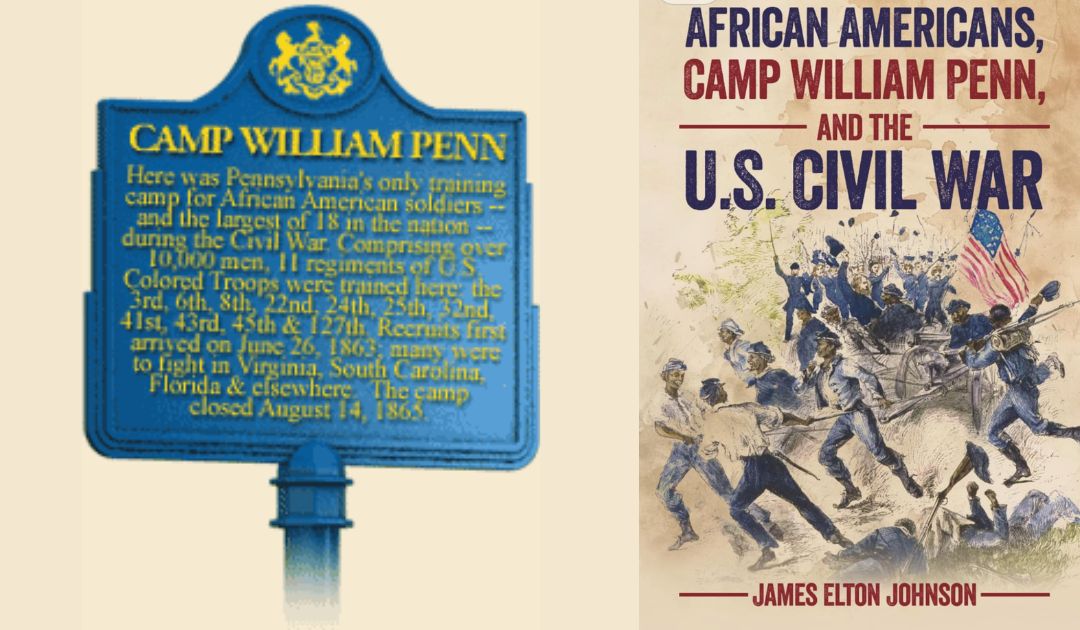
James Elton Johnson, PhD, recently published a new book titled “African Americans, Camp William Penn, and the U. S. Civil War”.
The book centers on Camp William Penn of Elkins Park (Cheltenham Township), known as the first and largest federal training camp for black soldiers during the Civil War.
From the book’s description on Amazon.com:
African Americans, Camp William Penn, and the U.S. Civil War is a meticulous, compelling account of the story of how African Americans became soldiers fighting for the freedom of Black people while fighting to save the Union from secession and insurrection. This is a splendid contribution to the study of the Civil War and emancipation, and the place of Camp William Penn within that context. Dr. Wayne Glasker, Professor Emeritus of History, Rutgers University
With poignant, clarifying detail, Dr. Johnson’s new book exceptionally explores the crucial socio-political challenges and even racist violence that Black people bravely faced in the 1860s and beyond. His particular focus on the establishment and history of Camp William Penn iterates the multifaceted efforts to raise Black regiments and explains how they were crucial before, during and after the epic Battle of Gettysburg fought July 1-3, 1863. Johnson enlightens readers with details and statistics painted with remarkable, often breathtaking, stories concerning heroic African Americans, empathetic military and political leaders, and anti-slavery abolitionists. Finally, Johnson skillfully bridges those “U.S. War” events to the formation of four army regiments (9th, 10th Cavalries & 24th, 25th Infantries) who, paradoxically, combated Native Americans in the immediate aftermath of the Civil War. Donald Scott, Sr., Historian-Author
The opening of the first and largest federal training camp for Black soldiers during the Civil War, Camp William Penn near Philadelphia, appears as a milestone in many histories of the war, but readers will here find a deeper, more complex, and nuanced examination that encompasses international events and relationships and political and legal arguments for and against the use of Black soldiers. The sweeping observations do not come at the expense of personal stories. As in Dr. Johnson’s other essays, the personal reflects the local, regional and national. The sum total is a brilliant account and analysis. It is also a moving and inspiring episode for the 250th anniversary year of the Declaration of Independence.
Robert D. Hicks, PhD, Emeritus Director, Mütter Museum & Historical Medical Library
College of Physicians of Philadelphia
For all the latest news, follow us on Facebook or sign up for Glenside Local’s “Daily Buzz” newsletter here.