
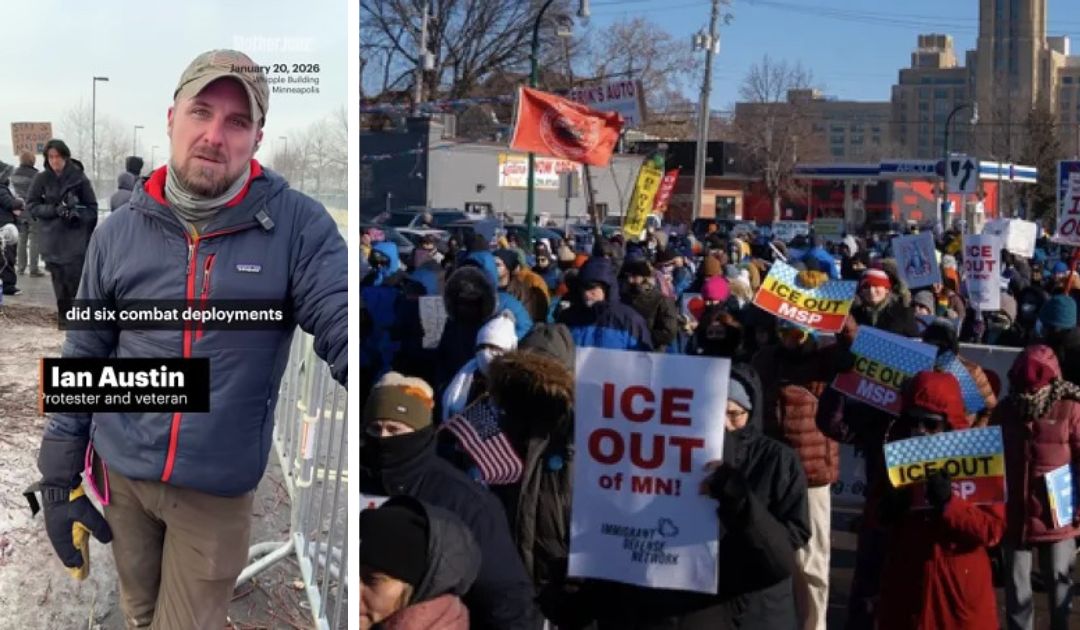
Ian Austin, 35, of Bryn Athyn, is one of nine people facing felony charges for their involvement in a January 18 protest at Cities Church in St. Paul, Minnesota, The Philadelphia Inquirer reported.
The protesters said they targeted the church because one of its pastors, David Easterwood, leads the Immigration and Customs Enforcement (ICE) St. Paul field office.
Austin, a Huntingdon Valley native and decorated U.S. Army veteran, said he believed it was his duty to travel to Minnesota in a video dated January 20.
“We’re turning into something that I can’t even begin to respect, and something that I literally went to war—or they told me I went to war—to fight against,” Austin said in the now-viral video, adding that he’d previously been detained for protesting outside the Bishop Henry Whipple Federal Building before being released without charges.
In 2021, Austin pleaded guilty to disorderly conduct and fighting after refusing to leave a local bar, The Inquirer said. He is currently being held in the Sherburne County Jail in Minnesota.
According to a federal indictment, Austin and other protesters “approached the pastor and congregants in a menacing manner, and near the end of the operation, loudly berated the pastor with questions about Christian nationalism and Christians wanting their faith to be the law of the land.”
“We took an oath to the Constitution, and it’s just being shredded right now,” Austin said. “This has all of the signs from every fascist movement in history that we’re going to lose the opportunity to resist. So that’s why I’m here.”
The video is below:
On January 22, the Philadelphia-based Foundation for Individual Rights & Expression (FIRE) posted an article titled “Anti-ICE protesters disrupted worship in a Minnesota church. Here’s why the First Amendment doesn’t protect their actions.”
“The constitutional line here remains clear. Protest in public forums is protected,” the post concludes. “Preventing others from engaging in private religious worship is not. Understanding and reaffirming that distinction is important, not in an effort to suppress dissent, but because we must preserve the conditions under which free expression, religious liberty, and civil society can endure together.
From FIRE’s post:
There is no First Amendment right to enter a house of worship and engage in conduct that effectively shuts down a religious service, even as part of a protest. Nor does anybody have the right to remain on private property after being asked by its owner or authorized representatives to leave.
The First Amendment offers its strongest protection to speech in traditional public forums — streets, sidewalks, and parks — while also protecting freedom of association, religious exercise, and freedom of conscience. A society committed to free expression depends not only on protecting speech, but on maintaining a clear delineation between protected speech, on the one hand, and unprotected civil or criminal conduct on the other.
The First Amendment restrains government action, not private individuals or institutions. Courts have long distinguished between public spaces, including those that must remain open to expressive activity, and private spaces where those who control them retain the right to exclude unwanted speech. Private property owners are not required to open their spaces to expressive activity simply because the message is political or morally urgent.
A worship service held inside a church is not a public forum. It is a private religious gathering, typically held on private property, convened for a specific and constitutionally protected purpose: religious exercise.
This distinction matters because the First Amendment is often misunderstood as an affirmative license to protest anywhere. It is not. It protects individuals from government suppression of speech; it does not compel private institutions to host expression they do not invite. Treating the First Amendment as a roaming permission slip for disruption misstates both the law and the logic of free expression.
According to FIRE, organizers Nekima Levy Armstrong and Chauntyll Louisa Allen were arrested for allegedly violating the FACE Act, which prohibits using force, threats, or physical obstruction to interfere with religious services.
Former CNN host Don Lemon, who was covering the protest, is also a defendant in the St. Paul incident.
For all the latest news, follow us on Facebook or sign up for Glenside Local’s “Daily Buzz” newsletter here.
Screengrab: Youtube | Photo: FIRE