
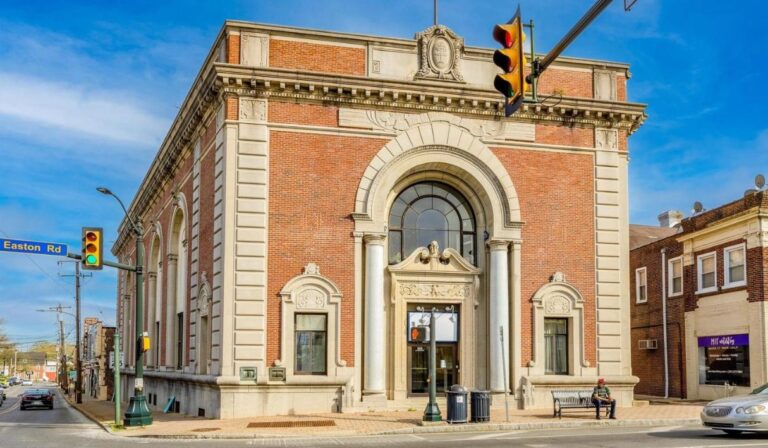
The Cheltenham Township Historical Commission included in its May 2025 issue a thorough background of the House of Magic building, located at 101 S Easton Road in Glenside.
The new entertainment venue opened in a former bank (most recently PNC), which was first chartered on February 10, 1910, according to Historical Commission chair Tom Wieckowski.
“On August 24, 1909, a group of community leaders formed what The Philadelphia Inquirer called ‘the first bank in the Easton Road area north of Philadelphia,'”, Wieckowski wrote. “The group was led by Julius E. Nachod, a Glenside resident and partner in the Philadelphia brewing firm of Class and Nachod, who served as first president of the new Glenside National Bank.”
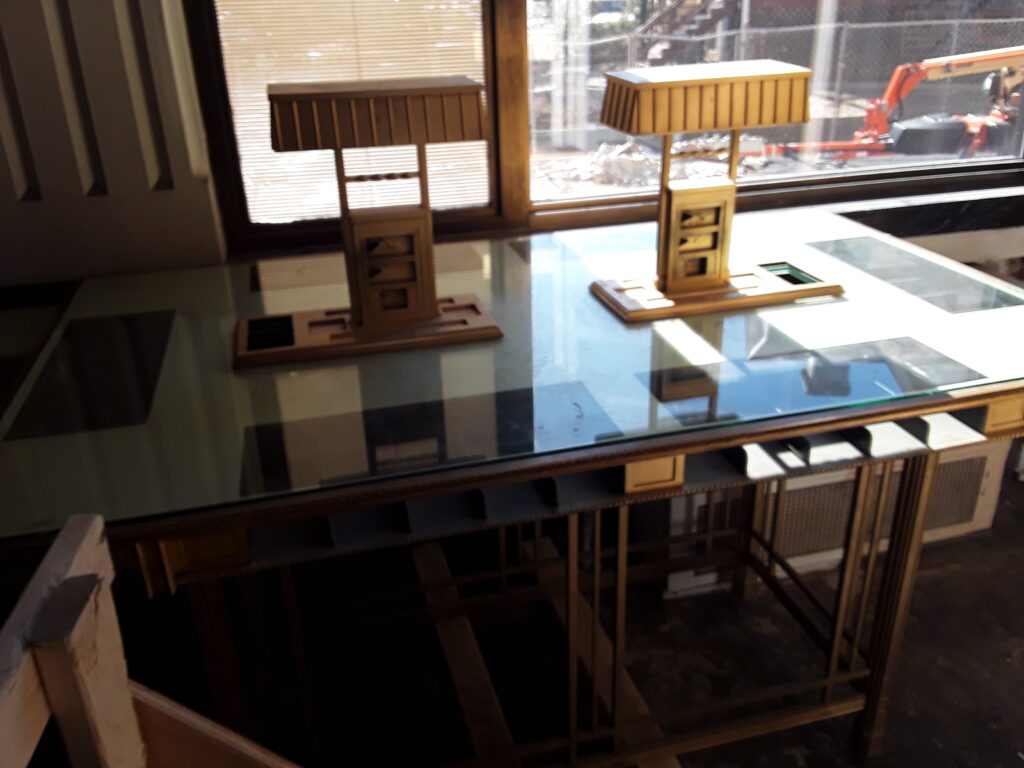
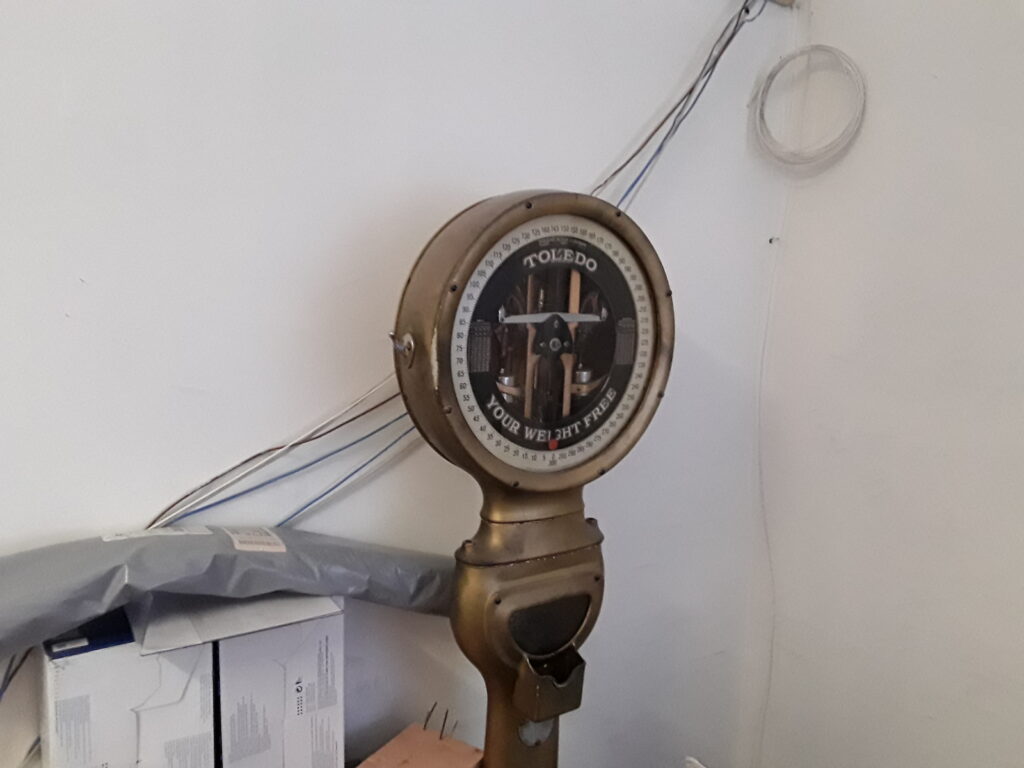

Wieckowski’s commentary continues:
Nachod was a Hungarian immigrant, born in 1846, who arrived in America in 1868. In the 1870s he lived on north 6th street and worked in various breweries, apparently gradually learning the trade before going into partnership with Charles Class In 1890. In a profile that appeared in The Philadelphia Times of May 18, 1894, he was described as “a man of system, the minutest detail must be understood. He is a man of few words. The great increase in the business must be ascribed largely to him.” The business apparently was very successful, as the Times noted that “Class & Nachod has secured in this city an enviable reputation for making a superior lager.”
With his success in business, Nachod first moved to a rented home in Glenside in 1887, location unknown, where his wife, Grace Benteen, died at the early age of 40 in 1893. There was no funeral. Only a year later, Nachod married Anna Gosewisch, a native of Delaware. He then purchased a hillside plot on the turnpike directly from Widener and Elkins in 1898 in what would soon become Glenside Farms. There he commissioned architect Charles Barton Keen to design a gracious home. The resulting property, which he named Edgewood, was featured in the October 1902 issue of Scientific American Building Monthly magazine, and it still stands.
Nachod appears to have thrown himself into the work of developing the new community. He was elected to the first board of directors of the Glenside Fire Company in March of 1900, elected to the Board of Commissioners of Abington Township about 1904, serving as the chair of the highway committee and the lighting committee in succeeding years. At the same time he joined the Glenside Protective Association whose mission was to improve living conditions in the neighborhood. One curiously anachronistic effort they undertook during his tenure was to force the post office to ban smoking in the Glenside post office. No documentation can be found to indicate whether their efforts were successful.
Nachod spearheaded the effort to form a bank and purchased a property next to the train station. The site quickly proved unworkable for the style of building Nachod wanted and he purchased a plot on the southeast corner of Glenside Avenue and the Germantown and Willow Grove turnpike, (now Easton Road) “one of the most desirable building sites in the business heart of the town” according to a report in The Philadelphia Inquirer of December 19, 1909. The building was completed in late August of 1910 and the new Glenside National Bank opened for business. The first Board of Directors included, among others, Nachod as president, the peripatetic Frank X. Renninger as director, along with Samuel D. Heist and Frank C. Justice, the lumber and coal yard proprietor. Nachod named his son, another Julius E. Nachod, as solicitor for the corporation. Julius, the son, apparently went by J. Ernest Nachod in order to avoid confusion with his father. He was a 1908 graduate of the University of Pennsylvania and had just completed his law degree at the same school when he was appointed.
Another new financial organization appeared in 1922 as the community continued its steady growth. The Glenside Title and Trust Company was invited to share quarters with the Glenside National Bank and by 1925 the two organizations merged. The combined organization had total assets of $2,982,588.97 upon its merger, a far cry from its initial capitalization of about half a million. Unfortunately, Nachod died suddenly in 1923 from a heart attack and did not live to see the expanded organization. Fritz Quittner served as interim president. Frank X. Renninger took over as president of the new Glenside Bank and Trust Company in 1925 and the success of the organization led to a decision to build a new larger and more opulent home for the bank. The bank moved its operation across Easton Road into one of Martin Luther Kohler’s stores on the opposite corner while the old bank was demolished. Construction was under way by August of 1928, and The Philadelphia Inquirer seemed particularly enamored with the four vaults that were being installed in the new building. On August 19, the newspaper in a boastful tone noted that “particular attention is being paid to the vaults. The walls of the vaults will be twenty-seven inches thick and of specially designed reinforced concrete. They will have a steel lining on the inside as additional protection.”
The new bank building of the Glenside Bank and Trust Company had its grand opening on December 14, 1929. The event “attracted thousands” according to The Philadelphia Inquirer and hundreds more political officials and banking executives. The Inquirer proclaimed that the new building “is equipped to [meet] requirements of a rapidly growing suburban area for many years.”
Sadly, the anticipated “many years” condensed into only two. Mankind labors with the trust that we can control the factors that impact our enterprises, as Nachod did with integrity, energy, and optimism, but we can be outpaced by forces of nature and society that arise to confound our efforts. Such was the case with the Great Depression that inflicted the nation as the new building opened that fall, and Glenside was not immune to its damaging forces. A steady seepage of deposits and shortfall in investments took its toll and on Saturday, October 3, 1931, bank president Frank X. Renninger gave the shocking order to lock the doors of the bank and suspend business. Glenside once again had no operating bank. The Philadelphia Inquirer the next day quoted Renninger’s explanation: “The directors decided it would be best, for proper conservation of assets, for the protection of all depositors, to suspend business and place all affairs in the hands of the banking Department of Pennsylvania. This action was absolutely necessary.”
On Tuesday, November 17, 1931, the Department of Banking announced that the assets of the institution would be liquidated. Worse yet, the Department announced that assets could be returned to investors only at an estimated 47% of their original value. The effort to enhance assets resulted in a public auction of several properties in Glenside that had been mortgaged by the bank. Thus, Julius E. Nachod’s contribution to the business life of the community was terminated after only twenty years.
You can also read the commission’s history of the original crossings at the Easton Road and Keswick Avenue railroad bridges, which was published in April.
For all the latest news, follow us on Facebook or sign up for Glenside Local’s “Daily Buzz” newsletter here.