
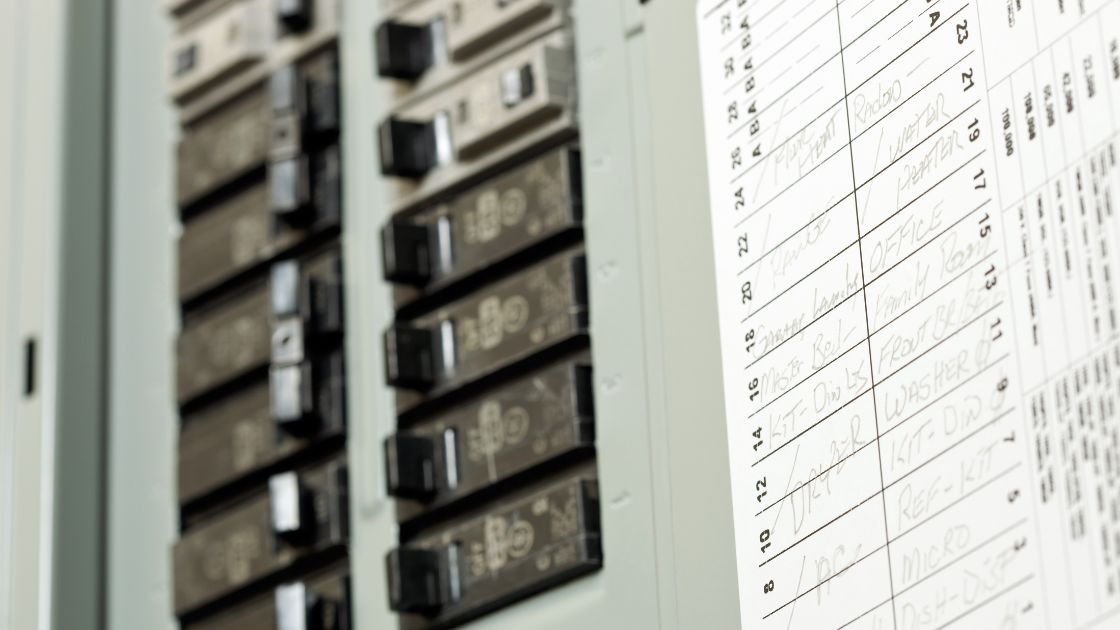
Glenside’s housing stock tells you something before you even knock on a door. More than half of it predates 1940, stone Colonials with slate roofs, Cape Cods tucked behind mature oaks, brick twins lining quiet streets near Keswick Village. Built with craftsmanship that holds up well. The electrical systems that came with them, or were patched together over the decades, often tell a different story.
What was adequate wiring in 1939 is a tight fit at best by any modern standard. These homes were never designed for central air conditioning, home offices, EV chargers, or the everyday reality of a microwave and a window unit running at the same time. That gap between what the system was built for and what modern households actually demand is exactly why older panels in Glenside deserve a closer look.
That’s not a reason to panic. It’s a reason to pay attention.
Signs Your Panel May Be Struggling
Older panels and outdated wiring tend to show their age in specific ways. Some are easy to miss. Others are harder to ignore.
The most familiar symptom is breakers that trip when the microwave and window AC run simultaneously. This means the circuit is drawing more current than the panel can comfortably handle, one of the most common complaints in older Glenside homes during summer.
Lights that dim when an appliance kicks on are a related warning. That flicker when the refrigerator compressor starts, or when the dryer begins a cycle, points to a voltage drop, a sign the system is being asked to do more than it was designed for.
More urgent symptoms include burn marks or discoloration around the panel or outlets, a burning smell, buzzing or crackling sounds from the panel, and a cover that feels warm to the touch. These are not quirks. Discoloration and heat buildup suggest a connection failing under load. Buzzing often means a breaker is no longer making clean contact.
A breaker that trips repeatedly, or resets and trips again immediately, is also worth taking seriously. A breaker that keeps tripping is doing its job. The question is what is causing it.
A Note on Federal Pacific and Zinsco Panels
If your Glenside home was built or renovated between the 1950s and 1970s, there is a reasonable chance it has a Federal Pacific Electric or Zinsco panel. Both were widely installed during that era, and both have well-documented safety concerns.
The core issue is breaker reliability. Federal Pacific Stab-Lok breakers can fail to trip during an overload, meaning the circuit does not shut off when too much current flows through it. Zinsco panels have their own failure history: internal arcing, overheating, and breakers losing contact with the bus bar. In both cases, the result is a breaker that does not trip when it should, leaving wiring to overheat without protection. That is a documented fire risk.
Pennsylvania insurers have taken notice. It has become increasingly common for carriers in this area to flag FPE and Zinsco panels during underwriting, and in some cases to decline or drop coverage until the panel is replaced.
You can check fairly easily. FPE panels often have “Stab-Lok” printed inside the door. Zinsco panels are recognizable by their colored breaker handles, typically red, green, blue, or yellow. If you see either, have a licensed electrician take a look.
What a Panel Upgrade Actually Involves
A panel replacement typically means installing a new 200-amp service panel, replacing the main breaker box, and bringing capacity in line with what modern homes require. A licensed contractor handles the full process:
- Coordinating with PECO for the service disconnect and reconnect
- Pulling the required Abington Township permit
- Removing the old panel and installing the new one
- Labeling circuits and testing the system
- Passing the township inspection before the job is complete
In most cases, the work is done in a single day. For most homes in this area, a 200-amp panel upgrade runs between $1,300 and $2,000, depending on your existing setup and whether any additional work is needed at the meter or service entrance.
Why This Matters Beyond Safety
An outdated panel shows up on home inspections. Buyers’ agents in the Philadelphia suburbs know what FPE and Zinsco panels are. When one appears in an inspection report, it triggers renegotiation, repair requests, or buyer hesitation. Replacing the panel before you list removes that variable entirely.
Insurance is the other pressure point. Coverage issues tied to older panels are not hypothetical for Glenside homeowners, they are an increasingly practical concern as insurers tighten underwriting criteria across the region.
And then there is what a 200-amp panel opens up. EV chargers require a dedicated 240-volt circuit and a panel that can handle the load. Kitchen and bathroom renovations almost always bump up against the limits of older panels. A modern panel makes all of that possible without workarounds.
If your Glenside home was built before 1960 and no one has looked at your panel recently, do not wait for a tripped breaker or an insurance letter to force the issue. Call Golden Electrical Service to schedule a panel inspection or upgrade consultation. The assessment takes less than an hour and gives you a clear picture of where things stand.

Golden Electrical Service
506 Brookwood Dr, Ambler, PA 19002
(267) 577-0550 | goldenelectricians.com